The trail she walked into
When Emma Gatewood set out from Mount Oglethorpe, Georgia, in the spring of 1955, the Appalachian Trail was already eighteen years old as a continuous marked footpath. Myron Avery and his volunteer crews had completed the continuous white-blazed route in 1937. Earl Shaffer had walked it end to end in 1948, the first person to do so — a feat the Appalachian Trail Conservancy, then still called the Appalachian Trail Conference, had initially doubted before Shaffer's photographs and diary settled the question. The trail's early culture was largely male, largely military in its language of endurance, and largely associated with purpose-built equipment: frames, canvas, leather boots, and loads that pressed down on the shoulders at fifteen or twenty kilos.
Gatewood was a grandmother from Gallia County, Ohio. She had raised eleven children. She had survived, over decades, a marriage of serious domestic violence. At an age when the trail's own literature barely imagined women completing sections, let alone the whole length, she announced she was going to walk to Maine. She had read a short item about the Appalachian Trail in a 1949 issue of National Geographic and concluded, based on the description, that it would be manageable. The description was not quite accurate; the trail was harder than advertised. She learned this the first time she attempted the route, in 1954, when she became lost in the Smokies and had to be assisted out. She came back in 1955 and finished.
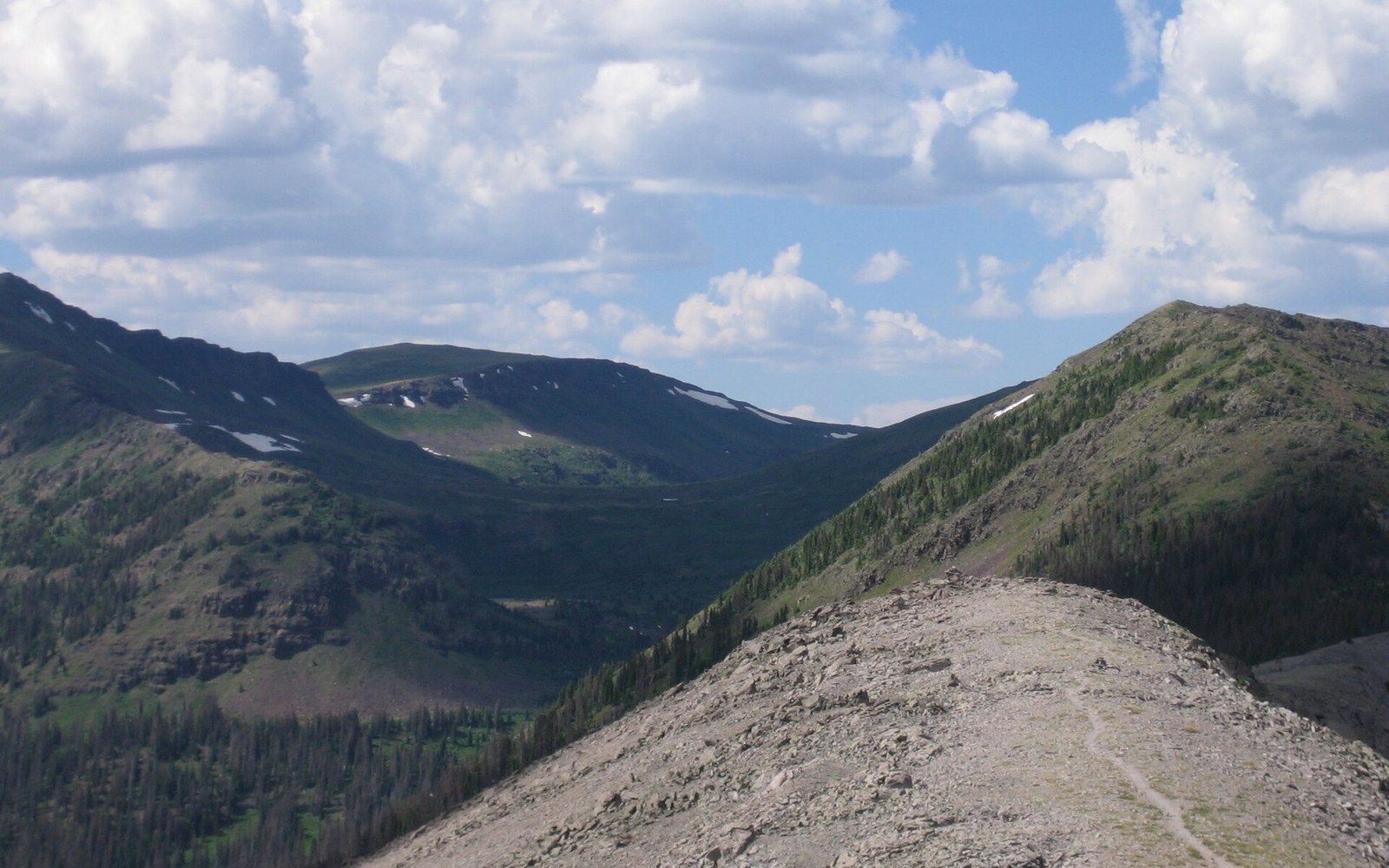
The Continental Divide Trail in the Weminuche Wilderness, Colorado. Discussed in The first reported end-to-end walk, in 1948.
Photo: Continental divide trail in Weminuche Wilderness · Wikimedia Commons
What she carried and why it mattered
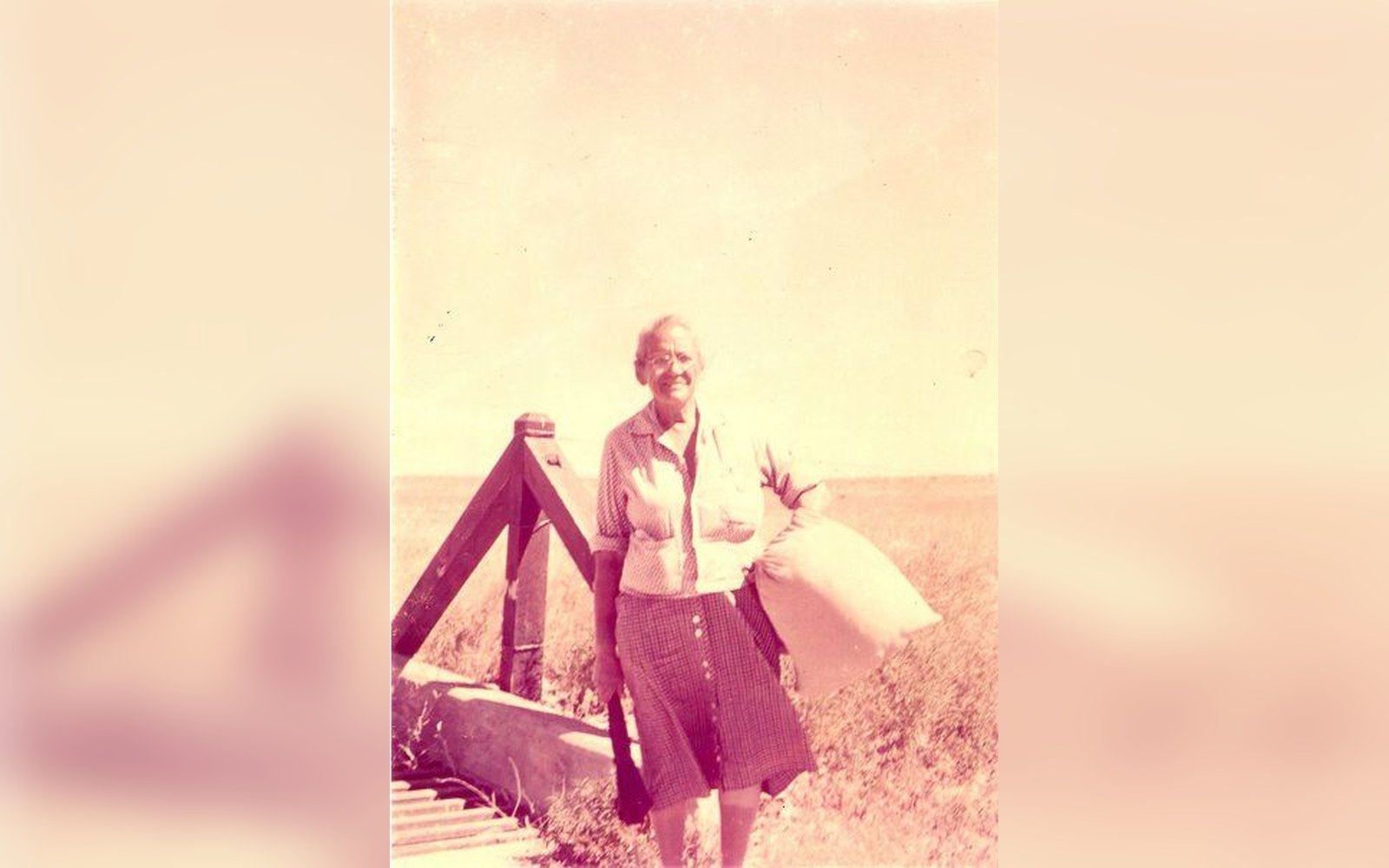
The equipment Gatewood brought to the trail in 1955 was not the equipment of the trail culture around her. She wore Keds — canvas sneakers, the kind bought in a general store. She carried a homemade denim bag, worn over one shoulder like a sack, rather than a framed rucksack. Inside it: a blanket, a raincoat, a plastic shower curtain used as ground cover, dried food, and a few basic items. She sometimes slept in barns or with trail-adjacent families when shelter was unavailable. She was reported, on finishing in Maine in September 1955, as having completed the trail's roughly 2,000-mile length — the precise figure has shifted as the route has been resurveyed over the decades, with the Appalachian Trail Conservancy placing the maintained length at approximately 2,198 miles as of recent surveys — without the standard apparatus of the serious backpacker.
This was not a gear philosophy. Gatewood did not write a book arguing that frames were unnecessary. She simply used what she could afford and carry, and she succeeded. The contrast with the prevailing idea of trail equipment was sharp enough that journalists noticed it immediately. The Associated Press ran a story on her finish. Sports Illustrated profiled her. The profile in Sports Illustrated in 1955 was among the earliest extended pieces in a major American magazine about a woman completing the Appalachian Trail, and it reached a readership that had not been paying close attention to long-distance walking as a practice.
The equipment gap between what Gatewood used and what the trail literature recommended said something that the trail literature had not quite managed to say itself: that completion did not depend on the right gear. This is not the same point Ray Jardine made forty years later when he systematically argued, in the context of the Pacific Crest Trail, that the ultralight turn was a philosophy of load reduction. Gatewood was not making an argument. She was demonstrating, practically, that the trail's demands were within the reach of someone who could not afford or did not want the full equipment complement. The cultural effect was significant even if it was not theorised at the time.
Chronology
- 1937Appalachian Trail completed as a continuous marked route under Myron Avery's leadership
- 1948Earl Shaffer reports first end-to-end thru-hike; verified by the Appalachian Trail Conference
- 1954Gatewood's first attempt; she becomes lost in the Smokies and does not finish
- 1955Gatewood completes the trail, Georgia to Maine; first woman to thru-hike it; AP and Sports Illustrated report the finish
- 1957Gatewood completes the trail a second time; first person of any gender to finish it twice
- 1964Gatewood walks the trail a third time, at 75, as a section hike
- 1968National Trails System Act gives the Appalachian Trail federal protection as a National Scenic Trail
- 2014Ben Montgomery publishes Grandma Gatewood's Walk
Three completions and a changed public image
Gatewood returned to the Appalachian Trail in 1957 and walked it again, becoming the first person of any gender to complete it twice. In 1964, at 75, she walked it a third time — this time as a section hike across multiple outings rather than a single continuous journey. These three completions, across a decade, meant she remained visible to the trail's public as the numbers of end-to-end walkers slowly grew.
Her first completion in 1955 coincided with a period in which the Appalachian Trail Conservancy was working to consolidate the trail's route and its public identity. The 1968 National Trails System Act, which placed the Appalachian Trail under federal protection as one of the first two National Scenic Trails, would come more than a decade later — but the public awareness work that made that legislation imaginable was already underway in the 1950s, and newspaper coverage of Gatewood contributed to it. She was good copy: elderly, female, lightly equipped, cheerful in interviews, and undeniably successful. Papers across the country ran wire-service items about her first finish. Her demographic profile directly contradicted the image of the trail as a young man's endurance test.
The question of who the Appalachian Trail was for had been present from the beginning. Benton MacKaye's 1921 article proposing the trail had imagined it in regional-planning terms — a spine for rural renewal and accessible recreation — rather than as a test for the fit and equipped. But the culture that grew up around thru-hiking in the years after Shaffer had a particular flavour, and Gatewood's three completions pushed against its assumptions without anyone having to frame the argument explicitly. She was simply there, and she had done it.
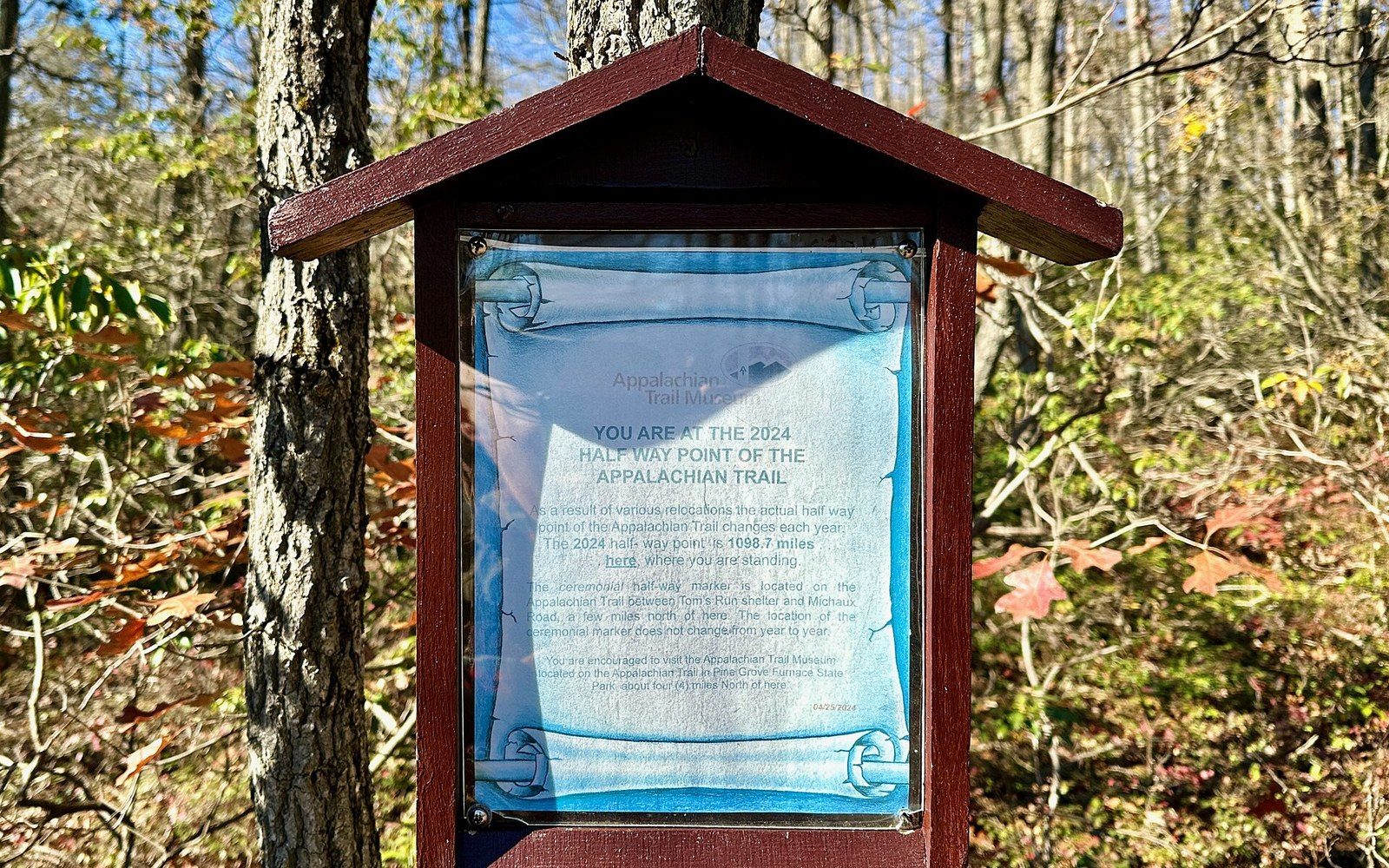
The Appalachian Trail’s 2024 halfway marker, Michaux State Forest, Pennsylvania.
Photo: Appalachian Trail 2024 Halfway Marker, Michaux State Forest, PA · Wikimedia Commons
By the time the 1970s backpacking boom arrived — driven by lightweight aluminium frames, freeze-dried food, and a generation shaped by environmental politics — there were enough women completing the trail that the image had genuinely shifted. That shift did not originate with Gatewood alone, but her documented completions were the earliest fixed points in the record, and the record is what the trail's history runs on. Trail registers — the logbooks kept in shelters and at road crossings along the route — preserve a continuous if partial account of who passed through; Gatewood's entries are part of that archive.
Her story circulated again in 2014 when Ben Montgomery published Grandma Gatewood's Walk, a book-length account drawing on family records, newspaper archives, and register entries. The book brought her to a new readership and was credited with prompting a fresh wave of interest in the history of who walked the Appalachian Trail in its early decades. The title she had acquired from journalists — "Grandma Gatewood" — had always had a slightly patronising edge, reducing a formidable and deliberate person to a figure of gentle surprise. The trail record underneath the nickname is straightforward: first woman to thru-hike the Appalachian Trail, first person to complete it twice, and at 75, still walking it in sections when most people with her history would have stopped long before.
Her story circulated again in 2014 when Ben Montgomery published Grandma Gatewood's Walk, a book-length account drawing on family records, newspaper archives, and register entries.
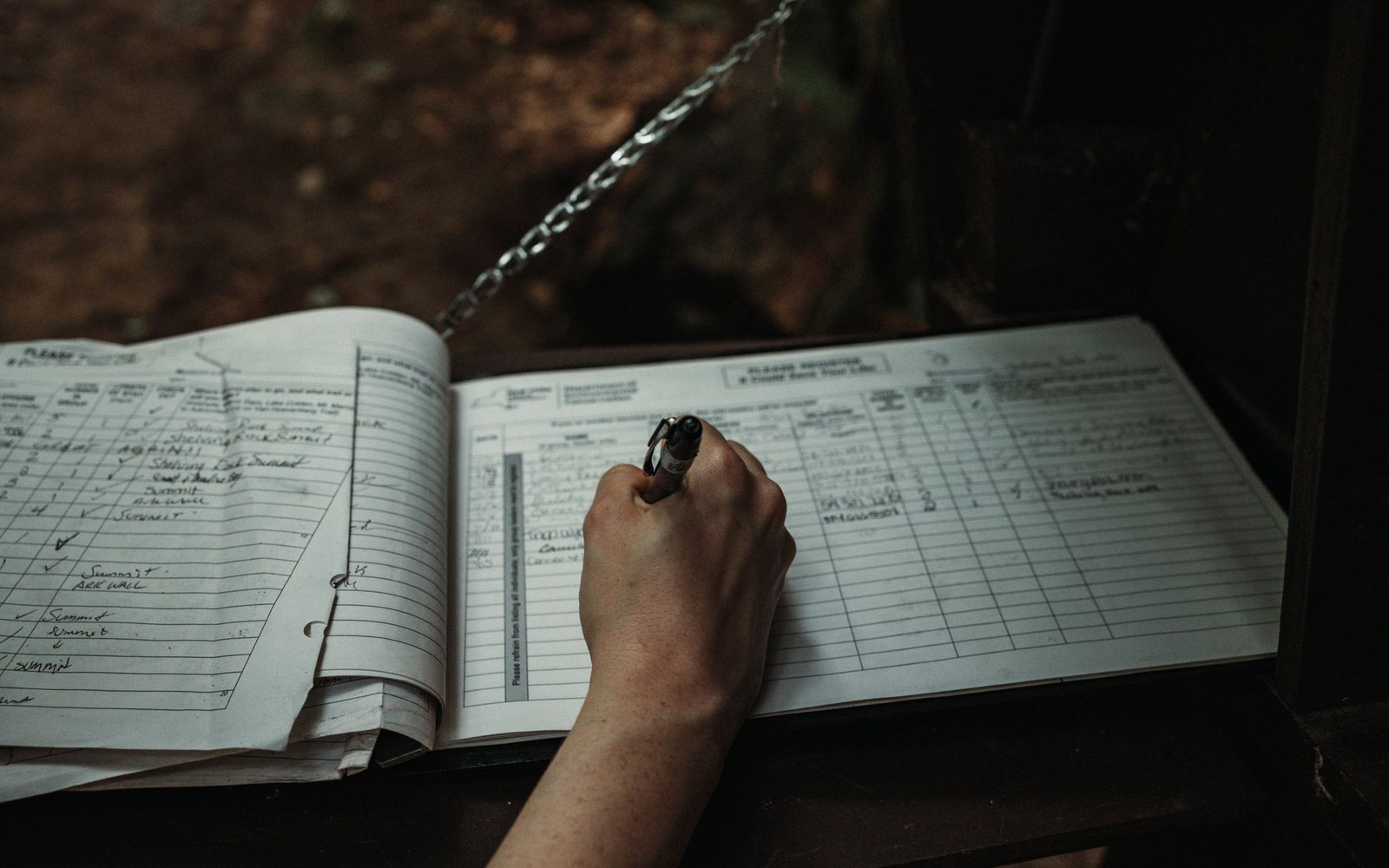
A trail register open on a shelter table. Discussed in Most people who start do not finish.
Photo: Connor Scott McManus / Pexels
What she carried
- Footwear
- canvas Keds sneakers, not leather boots
- Pack
- homemade denim bag worn over one shoulder; no frame
- Shelter layer
- plastic shower curtain as ground cover; blanket
- Rain
- a basic raincoat
- Food
- dried provisions; supplemented by stays with local families and in barns
More in First walks and counted ones