
The Weight-Durability Exchange
When Ray Jardine's approach in the 1990s treated every gram as guilty until proven innocent, the results were genuinely transformative. Pack weights that had sat at fifteen or twenty kilos for decades fell toward five. But the physics of that reduction has always been straightforward: less material means less mass, and less mass means less of everything — less abrasion resistance, less insulating loft, less structural redundancy.
The fabrics tell the story most plainly. A conventional nylon tent floor woven at 70 denier resists puncture and ground abrasion across many seasons of use. The silnylon and Dyneema composite fabrics that enabled the sub-kilogram shelter weigh a fraction as much because the fibres are finer and the weave is thinner. A 10- or 15-denier floor is not defective engineering; it is a deliberate trade. The hiker carries less; the material tolerates less. Ultralight shelters have always required groundsheets or careful site selection precisely because the floor itself cannot absorb the abuse a heavier one could.
Insulation follows the same curve. Down sleeping bags are rated by fill power — a measure of how much volume an ounce of down occupies — and the drive toward lighter bags pushed fill power ratings upward while simultaneously thinning the shell fabric. High fill-power down degrades faster under compression and moisture cycles than a lower-fill bag with the same warmth rating and a more robust casing, because the shell fabric that protects the clusters has been reduced to save weight. A bag that lasted fifteen years in a 1980s pack may last five in a contemporary ultralight one used at the same frequency.
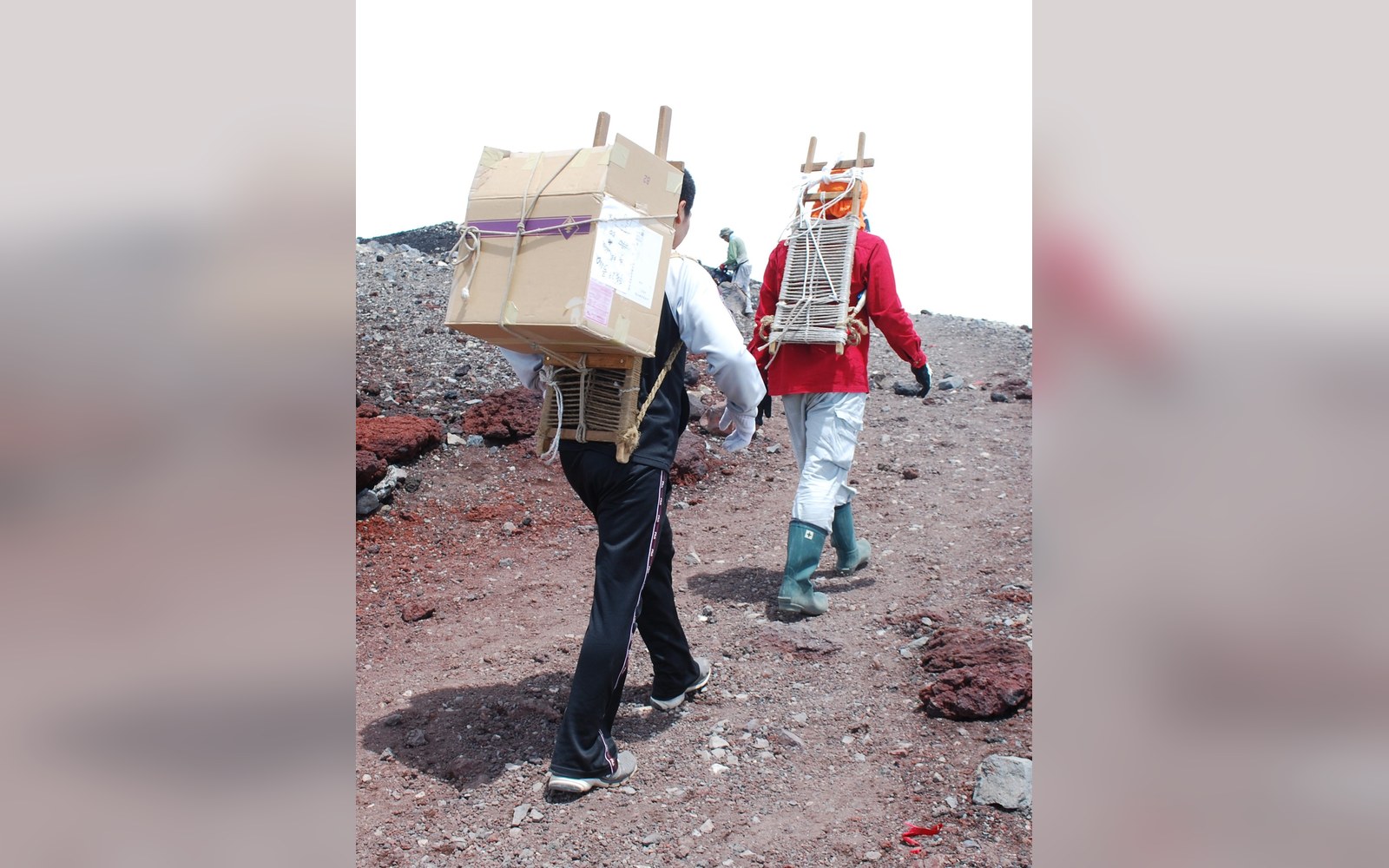
Shoiko external-frame loads carried on Mount Fuji, Japan. Discussed in What a 1970s pack actually weighed.
Photo: External frame packs,Shoiko,Mt.Fuji,Japan · Wikimedia Commons
Where the Margin Goes
The phrase "margin" carries real meaning in gear engineering. A heavier boot carries structural margin: the shank resists twist, the upper resists side-loading, the sole resists wear long enough that the hiker reaches the next town without a blowout. Trail-runners and lightweight footwear — which now dominate ultralight hiking practice — offer less of all three. Their outsole compounds wear measurably faster on abrasive granite than a traditional Vibram lug. Manufacturers state this openly in product documentation; the lighter shoe is not built for the same lifespan, because lifespan would require mass.
Backpack bodies compress the same lesson into stitched seams and hipbelt foam. Frameless packs built from Dyneema composite fabric are extraordinary objects: waterproof, tear-resistant for their weight, and genuinely capable of covering thousands of trail miles. But the Dyneema composite fabric that makes them possible does not respond well to UV exposure over multiple seasons the way a heavier coated nylon might, and the absence of a frame means load stress concentrates in the stitching rather than distributing across a rigid structure. A seam that pops on day eight of a remote route is a different problem from one that pops in the driveway.
None of this makes ultralight gear worse in any absolute sense. A hiker who replaces a £180 shelter every four seasons and carries 2.5 kilos less for a decade has made a defensible calculation. The point is simply that the calculation exists and needs making. The gear industry's marketing cycle consistently presents the weight saving and consistently underplays the durability exchange, because the exchange encourages repeat purchase in a way that a bomb-proof tent does not.
A technical woven fabric at macro range.
Photo: Matheus Bertelli / Pexels
What the ultralight turn genuinely achieved was to make the weight-durability trade visible and deliberate in a way it had not previously been. Hikers who understood the bargain could accept it on their own terms. Those who did not sometimes discovered it at the worst possible moment, far from a trailhead and holding something that had simply run out of material to give.
The core trade-off
- Denier
- the unit of fabric fineness; lower denier = lighter = less abrasion resistance
- Fill power
- how much volume an ounce of down occupies; higher fill power enables lighter bags but typically pairs with thinner shell fabric
- Structural margin
- the engineering buffer between designed load and failure load; ultralight gear carries less of it by definition
Frameless packs built from Dyneema composite fabric are extraordinary objects: waterproof, tear-resistant for their weight, and genuinely capable of covering thousands of trail miles.

An ultralight cook kit laid out in a tent. Discussed in One walker's argument cut the load by three quarters.
Photo: Mykhailo Petrushchak / Pexels
Chronology of the shift
- 1990sRay Jardine's writing popularises deliberate gram-counting; ultralight as a philosophy rather than a cost-cutting measure
- 2000s–2010sDyneema composite fabric (then Cuben Fiber) enters the cottage-industry pack and shelter market
- 2010s–presentTrail-runners displace leather boots across most ultralight hiking practice; manufacturer-stated outsole lifespans shorten accordingly
More in Twenty kilos to five