The difference between a track and a trail is mostly invisible until the rain comes
A footpath that exists because people walked it — a desire line beaten into grass, a shortcut across a hillside — is not a sustainable trail. It is a gully in waiting. Water follows foot traffic as reliably as foot traffic follows the easiest line, and where the two coincide, the path eats itself. Sustainable trail is made differently: it is designed, cut to a specified grade, and shaped so that rainfall leaves it rather than runs along it. The engineering is mostly invisible to anyone walking in dry weather. It becomes obvious in the first heavy downpour.
The practice has a vocabulary. Grade is the simplest figure: the percentage rise over horizontal distance. A ten-percent grade gains ten metres for every hundred metres of travel. Sustainable trail is generally held below ten percent, because above that threshold rainfall accelerates enough to detach soil rather than carry it in thin sheet flow. The number is not absolute — rock trails can hold steeper grades — but it anchors the discipline. A path that climbs straight at fifteen or twenty percent, taking the fall line directly, will begin to channel water within a season or two and become a muddy scar within five.
The complementary principle is outslope: the trail tread is angled very slightly, typically three to five percent, toward the downhill side of the slope. Water that falls on the tread sheets off the edge rather than pooling or running along the path. This is not the same as a cross-slope; it is a deliberate tilt built into every metre of construction. Done well it is imperceptible underfoot. Done badly, or not done at all, the tread becomes a pipe. The Appalachian Trail Conservancy's trail construction and maintenance standards encode both grade and outslope as baseline requirements precisely because the volunteers who maintain the trail's more than three thousand five hundred kilometres of tread need consistent reference figures, not rules of thumb.
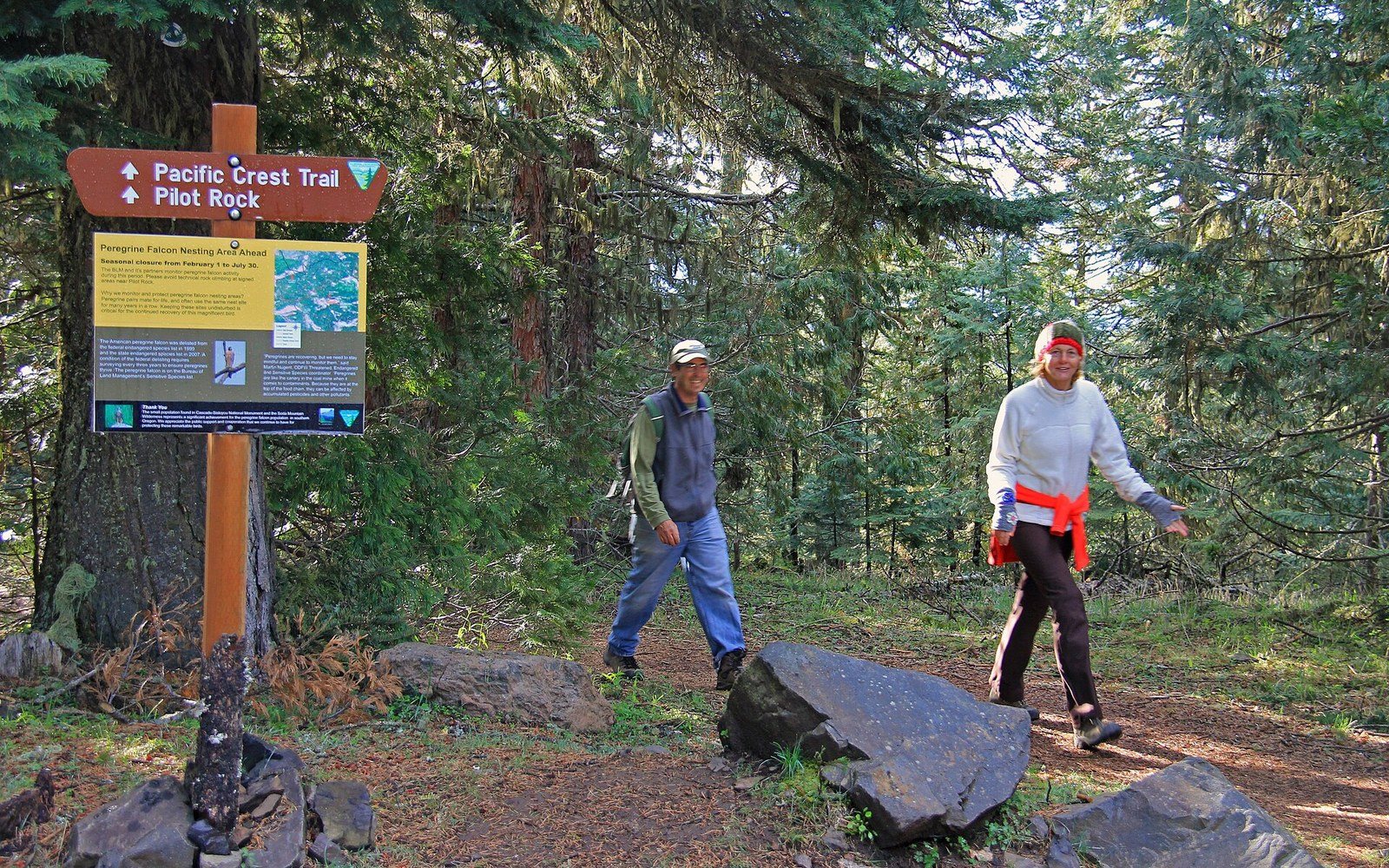
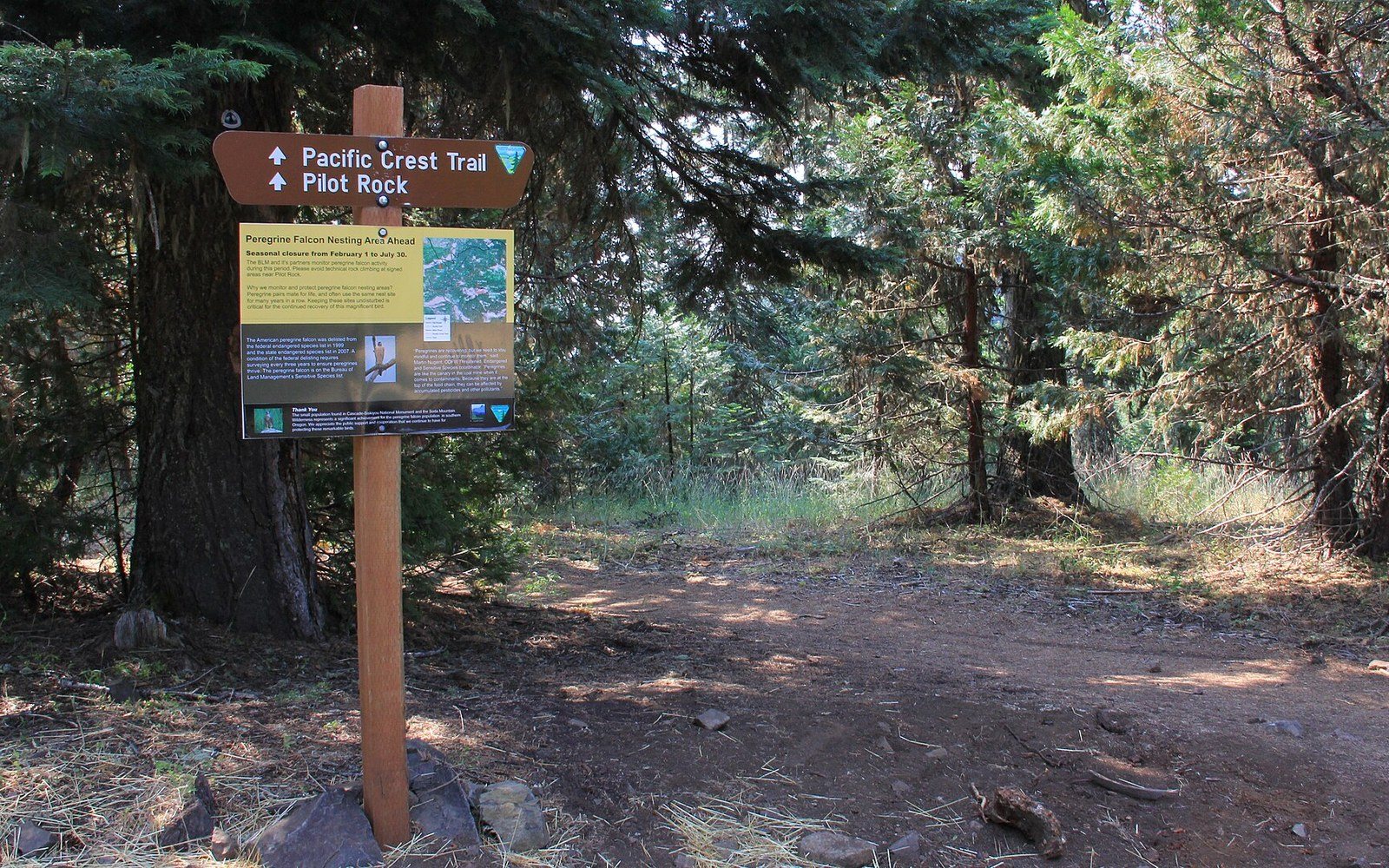
A Bureau of Land Management sign on the Pacific Crest Trail, Oregon. Discussed in Every trail problem is a water problem.
Photo: BLM and the Pacific Crest Trail Oregon · Wikimedia Commons
Half-on, half-off — and what happens when it isn't
The structural idea behind a cut trail on a hillside is sometimes called the half-on, half-off method: roughly half the tread sits on undisturbed mineral soil, and the other half is built outward on fill compacted against a bench cut into the slope. The berm of displaced material — the spoil from the cut — is cleared entirely from the uphill edge, or it acts as a dam. Water from the hillside above must be able to reach the tread and sheet across it and off; if the spoil sits against the slope, water ponds on the uphill edge instead. A ponded tread saturates, softens and fails.
These principles are old in practice and relatively recent as documented standards. The trail-building guides produced in the twentieth century for the Appalachian Trail, and later systematised by the Pacific Crest Trail Association for the Pacific Crest Trail, were among the first attempts to turn empirical maintenance knowledge into transferable specification. The PCT's particular challenge — long traverses across exposed Sierra Nevada and Cascade slopes — made consistent tread geometry a physical necessity rather than an aspiration.
Water bars and drainage dips complement the tread shape where grade is unavoidable, or where the trail must run parallel to slope long enough for flow to accumulate. A water bar is a barrier, traditionally a log or a shaped rock set diagonally across the tread, angled to throw water off the edge before it builds speed. A drainage dip — also called a grade dip or rolling dip — is a low point cut into the tread itself, sloped to drain on the exit. Of the two, drainage dips are generally more durable: they have no element to rot or be displaced, and they work passively with the grade rather than interrupting it. The distinction matters to maintainers because a water bar that has shifted or rotted does nothing, and on a steep section can make ponding worse. As the Wikipedia article on trail construction notes, the rolling grade dip became preferred practice on high-use trails through the latter decades of the twentieth century partly for this reason.
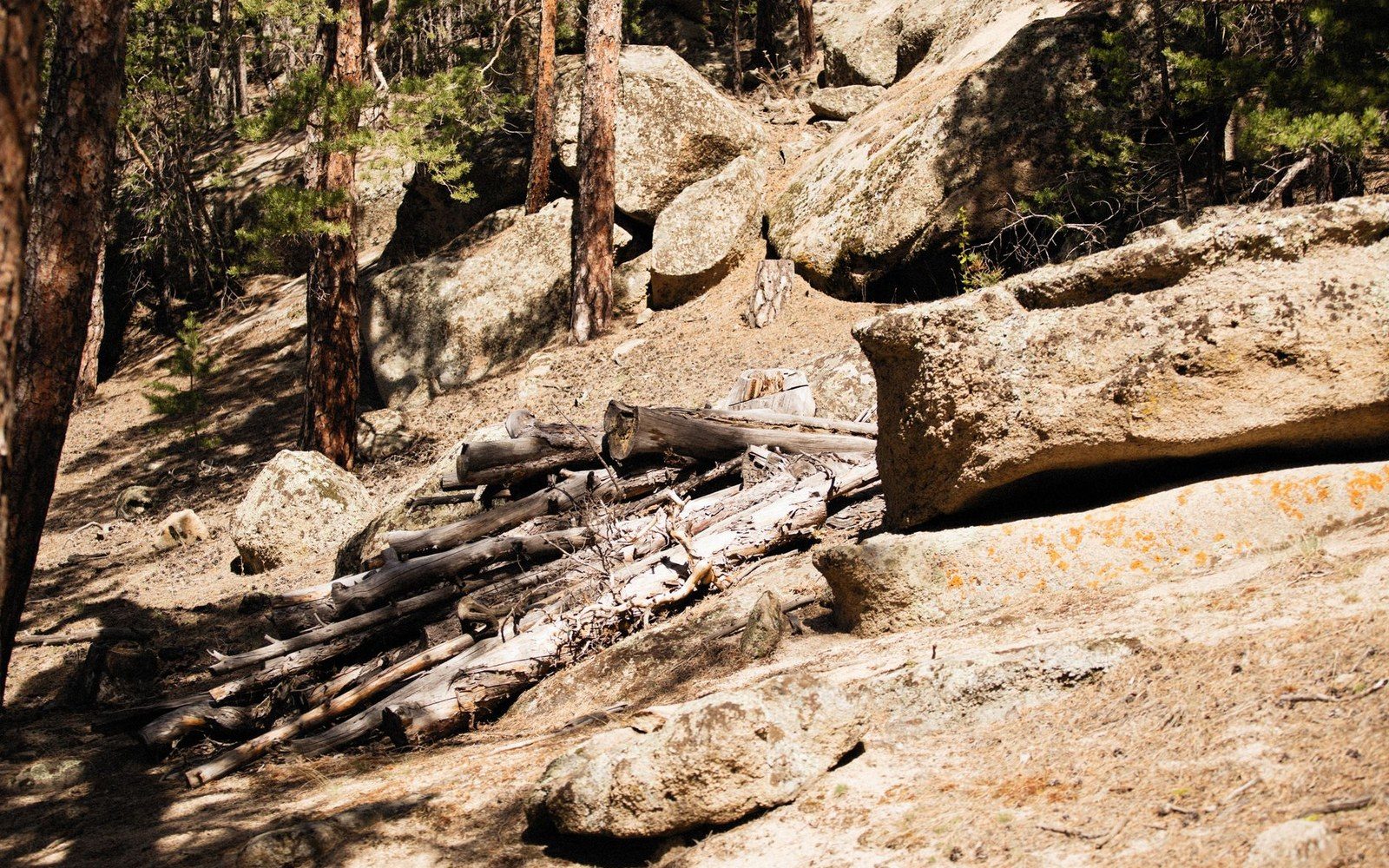
A cut trail bench on a steep slope.
Photo: Alexey Demidov / Pexels
Turnpiking is a different answer to a different problem. Where a trail crosses a wet flat — a boggy col, a marsh approach, a seasonally flooded valley bottom — grade and outslope are irrelevant because there is no slope to drain off. The solution, borrowed from the road-building practice that gave it its name, is to raise the tread above the surrounding ground on a bed of compacted material, sometimes corduroy (logs laid perpendicular to the route), sometimes stone, sometimes geotextile and gravel in modern construction. The raised surface sheds water to both sides. It also prevents the kind of spreading that happens when walkers step around a muddy section, widening the corridor of damage until the bog is a trampled field.
Chronology of construction standards
- Appalachian Trailfirst formal trail-maintenance guidelines developed across the early-to-mid twentieth century by the Appalachian Trail Conservancy and its predecessor bodies
- Pacific Crest Trailconstruction specifications formalised in the latter twentieth century by the Pacific Crest Trail Association, codifying grade, outslope and drainage dip standards for high-use mountain terrain
- Rolling grade dipdisplaced water bars as preferred practice on high-use trails during the latter decades of the twentieth century
Why it has to be built, and why it keeps being built
The reason trail construction is a continuing activity rather than a one-time project is that tread fails. Mineral soil compacts under foot traffic, reducing its capacity to absorb water and increasing surface run-off. Tree roots exposed by wear create trip hazards and capture flowing water, accelerating erosion on either side. Freeze-thaw cycles heave stone and break up compacted fill. On a trail carrying tens of thousands of pairs of feet a year — the Appalachian Trail's busiest sections carry figures in those ranges — the maintenance cycle is measured in years, not decades.
The labour involved is what makes volunteer organisation essential. The Appalachian Trail Conservancy coordinates more than thirty trail-maintaining clubs, each responsible for an assigned section. The Pacific Crest Trail Association maintains a parallel structure. Most of the physical work — swinging a Pulaski to recut a failing outslope, hauling rock for a step or a water bar, clearing spoil from a bench — is done by people who are not paid for it. The infrastructure looks simple from above, but the engineering that keeps a dirt path from becoming a ditch runs through every metre of it, and someone has to keep renewing it. A trail is not worn into existence. It is cut, shaped, drained — and then cut again.
The infrastructure looks simple from above, but the engineering that keeps a dirt path from becoming a ditch runs through every metre of it, and someone has to keep renewing it.
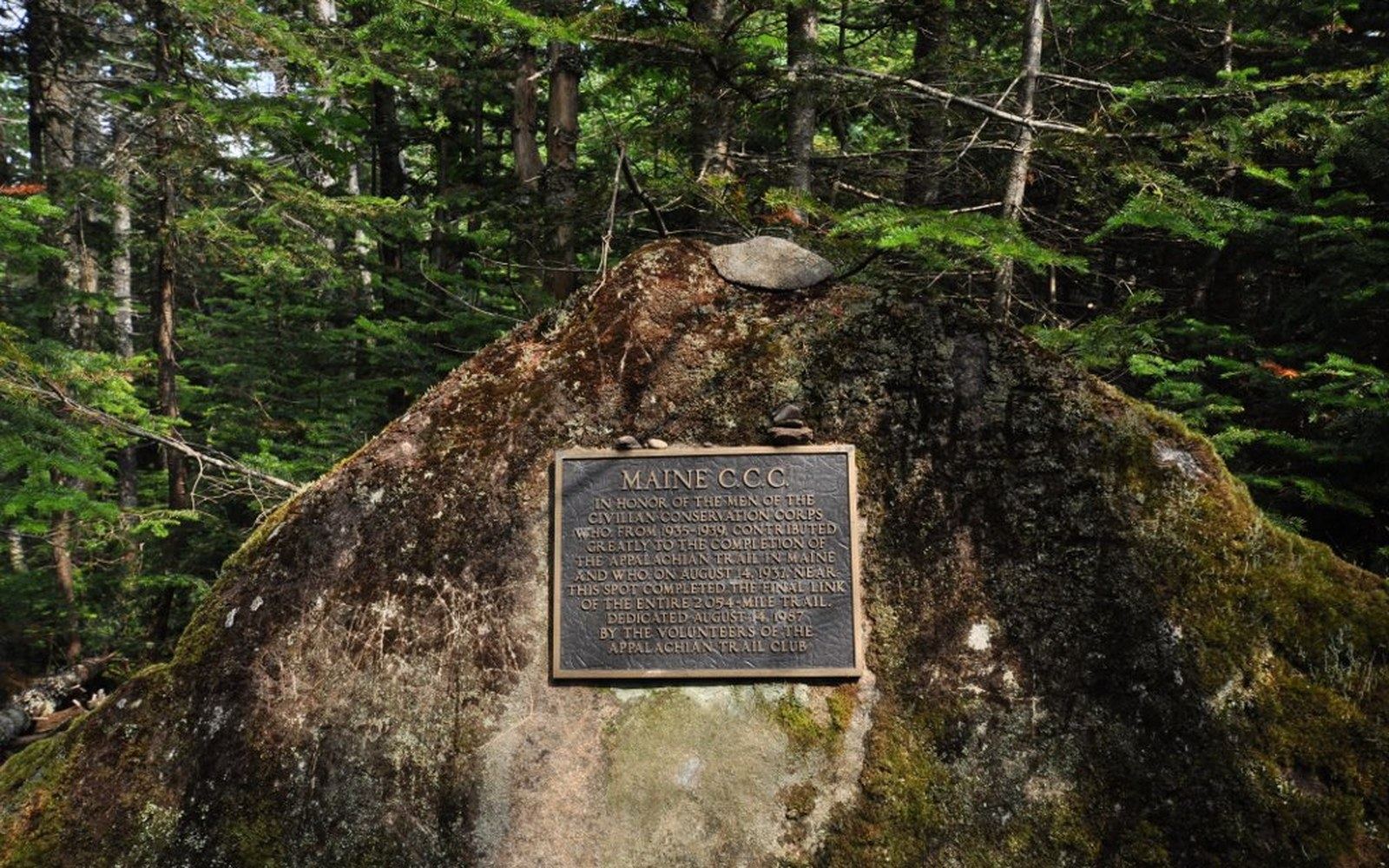
The Maine C.C.C. marker at the point where the final link of the Appalachian Trail was closed in 1937. Discussed in Volunteers hold most of it together.
Photo: AppalachianTrailInMaineCompletionMarker · Wikimedia Commons
Key construction terms
- grade
- percentage rise per horizontal distance; generally held below ten percent for sustainable trail
- outslope
- three-to-five percent tilt of the tread toward the downhill edge, shedding water off the surface
- half-on, half-off
- bench-cut method where half the tread sits on undisturbed soil, half on compacted fill
- water bar
- diagonal barrier across the tread (log or rock) that diverts surface water off the edge
- drainage dip / rolling dip
- a low point cut into the tread itself; drains passively and has no element to rot
- turnpiking
- raised tread across flat wet ground, borrowing the road-building technique of the same name
- corduroy
- logs laid perpendicular to the route as a base for raised tread in boggy sections
- Pulaski
- combination axe-and-adze hand tool standard in trail construction and maintenance
More in The path as a built object